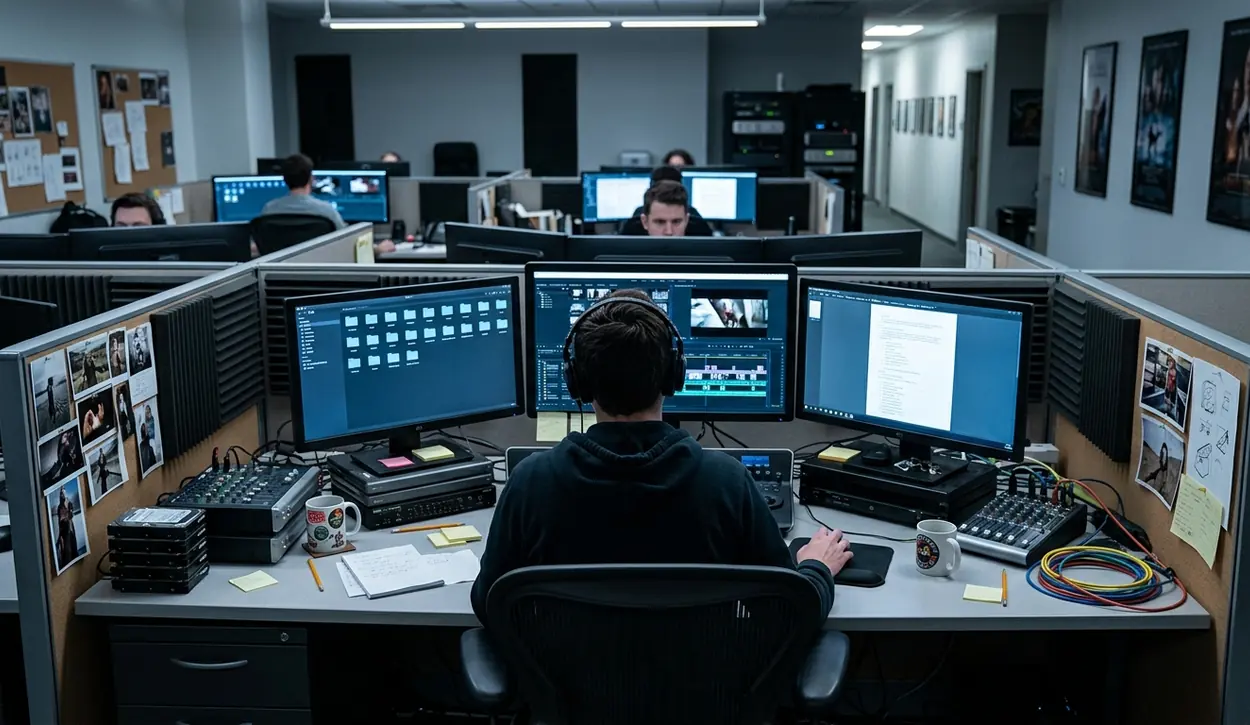
The Anatomy of a Studio's Visual Manifesto
Production reels function as living records of what a studio can actually deliver. At Exopolis, these artifacts captured the moment when interactive web projects began sharing space with broadcast motion work.
The case study traces how one studio turned scattered archives into a single, coherent statement that supported measurable growth.
The Challenge: Archiving Interactive and Linear Media
Months of interactive campaigns had to fit inside a two-minute linear cut. Screen capture sessions of interactive campaigns required 60fps recording to prevent motion tearing during Flash-to-video conversion.
Condensing 15-minute user journeys into 3- to 5-second linear cuts created real risk of cognitive overload when 3D animation sat next to Flash interfaces.
Internal discussions often circled around which projects counted as current identity versus legacy work.
Theoretical Framework of Visual Portfolio Curation
Editors applied principles of visual communication to rapid editing sequences. The Gestalt effect operated across the entire reel, so the combined clips shaped one impression of studio capability.
Rhythmic retention became the practical measure: pacing had to let viewers register specific skills without fatigue. Targeting a rhythmic retention threshold of roughly 12 to 18 frames per micro-interaction kept sequences under the 120-second limit.
Solution: Thematic Editing and Strategic Sequencing
Thematic grouping replaced chronological order. Projects were clustered by motion behavior rather than client or date.
Macro-to-micro sequencing opened with atmospheric environment shots before moving into detailed UI moments. Standardizing mixed frame rates (29.97fps broadcast, variable web, 60fps interactive) to a unified 24fps timeline and applying a baseline Rec.709 color transform produced a single visual language.
Legacy Media Standardization Parameters| Source Format | Native Frame Rate | Conversion Target | Color Normalization |
|---|---|---|---|
| ActionScript 2.0/3.0 (SWF) | Variable (12-30fps) | 24fps (Optical Flow) | sRGB to Rec.709 |
| Broadcast Master (DigiBeta) | 29.97fps | 24fps | Rec.709 |
Solution: Sound Design as the Cohesive Glue
Custom audio tracks supplied the narrative spine. Layering 4 to 6 distinct audio stems per transition gave disparate clips a shared texture.
Foley and synchronized effects anchored abstract graphics. Sub-bass frequencies (40-60Hz) supported heavy 3D motion while high-pass clicks aligned with web navigation states.
Scope and Limitations of the Linear Reel
A passive video cannot fully stand in for active, user-driven interfaces. The editorial team excluded any interactive project needing more than three seconds of on-screen text to explain its mechanics.
UI demonstrations stayed at top-level navigation and primary conversion states. One catch: relying solely on a linear reel to demonstrate interactive capabilities falls flat when pitching complex UX architecture, requiring supplementary written case studies to close technical contracts.
Results: Client Acquisition and Cultural Footprint
After release, pitch presentation time dropped from about 45 minutes to 20 minutes. The reel also preserved over 400 gigabytes of legacy interactive campaigns in one master file.
Talent teams noticed higher retention among senior motion designers who saw their cross-disciplinary work represented clearly. The document now serves as the clearest record of the studio's peak output during the Exopolis years.