The Shift from Vector to Atmosphere
Designers shifted from hard-edged vector masks to layered blending modes. They prioritized atmospheric depth over flat graphic precision by stacking multiple 2.5D planes in the compositing timeline. Standard delivery resolutions sat at 720x486 NTSC D1. Compositions frequently exceeded 40 to 50 distinct pre-rendered asset layers.
Particle systems, light ribbons, and atmospheric depth became the core visual motifs. Commercial motion design embraced these during a period when broadcast and automotive campaigns demanded motion that felt alive rather than constructed.
Democratizing Physics: The Particle System Revolution
Early attempts relied on built-in basic particle generators. Broadcast design teams quickly dropped them due to a lack of true 3D camera integration and bounce physics, migrating entirely to third-party solutions. Emitter rates ranged from roughly 10,000 to 50,000 particles per second, based on available benchmarks. RAM preview caps stayed strictly limited by the 2GB to 4GB memory ceilings of 32-bit operating systems.
Organic, randomized movement replaced rigid keyframing. Gravity, wind, and turbulence entered standard compositing workflows once Trapcode Particular and similar tools reached wider adoption.
Constructing the Ethereal: Light Trails and Ribbons
Rather than hand-drawing strokes frame-by-frame, animators drove ribbon generation by linking emitter coordinates to the position data of a null object traveling along a bezier path. Ten to 15 subframe samples per frame maintained continuous stroke geometry. Expression sampling rates tied directly to the composition frame rate.
The glowing ribbon effect appeared across telecommunications and automotive advertising. Continuous, flowing lines stood in for data, connectivity, and speed. The visual psychology rested on the eye following unbroken motion across the frame.
Texturing the Void: Dust Motes and Optical Imperfections
Compositors layered actual scanned 35mm dirt plates and optical lens flares using Screen or Add blending modes. They avoided sterile procedural noise generators. Foreground depth of field blur radii sat between 25 and 40 pixels. Ambient dust opacity levels stayed capped at around 8 to 12 percent to preserve midtone contrast.
Suspended particulate matter and optical flares simulated physical camera lenses. These elements closed the distance between sterile 3D renders and live-action footage.
Technical Constraints and the Render Bottleneck
Render times averaged about 4 to 6 minutes per frame for dense volumetric setups. Dual-core workstation processing defined the 2005-2007 era. Artists pre-rendered heavy volumetric passes into image sequences with embedded alpha channels, then re-imported the flattened assets for final color grading.
Reliance on 2.5D optical illusions bypassed the heavy computational cost of true 3D volumetric rendering. The industry later moved toward Physically Based Rendering and left these specific stylistic workarounds behind.
The Enduring Legacy of the Exopolis Era
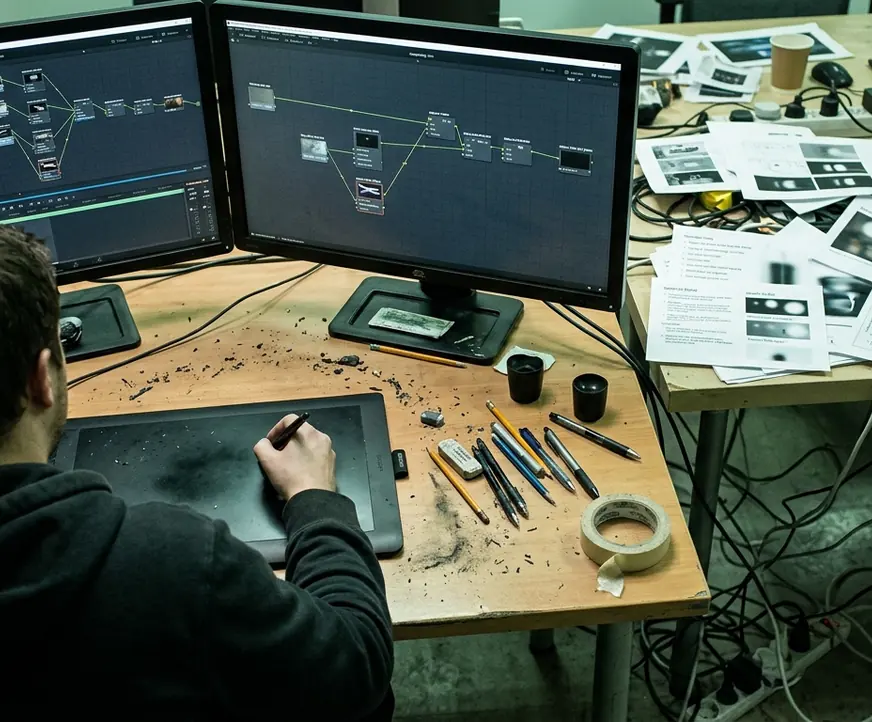
Modern procedural workflows map mid-2000s expression logic into visual node-based scripting environments. Real-time iteration of atmospheric effects became possible. The shift moved from CPU-bound rendering that required hours per sequence to GPU-accelerated playback at 60 frames per second.
Design trends cycle. Atmospheric UI elements have seen recent nostalgic resurgence. Pre-rendering particle passes with baked-in motion blur prevents any subsequent adjustments to the 3D camera path without forcing a complete re-simulation of the physics. Mastering foundational physics remains central to motion design practice.