Defining the Interactive Creative Director
I remember reviewing portfolios at the digital creative agency Exopolis when the industry began its aggressive pivot from traditional advertising to interactive digital experiences. We stopped looking purely at art direction—the medium demanded a different kind of literacy. Defining the role required shifting hiring criteria from pure art direction to hybrid portfolios. Creative leads began evaluating candidates by asking them to storyboard a user flow and map out logic.
In practice, transitioning a traditional print-focused art director to an interactive lead typically required a 12- to 18-month immersion period in basic object-oriented scripting logic to effectively evaluate technical feasibility. You could not direct what you did not understand structurally.
This baseline requirement of dual literacy in both visual design and code architecture separated the successful campaigns from the broken ones.
Synthesizing Motion and Non-Linear Design
Attempting to force traditional broadcast motion graphics pipelines into interactive web builds without accounting for client-side memory limits resulted in browser crashes during the preloading phase. Early attempts to export full 30-frame-per-second linear video sequences directly into interactive timelines resulted in massive file sizes that choked standard broadband connections. We had to find a middle ground between cinematic fidelity and functional delivery.

The alternative approach proved necessary for survival. Compressing high-end cinematic assets for web deployment often meant reducing video bitrates to between 400 and 600 kbps while maintaining a 24 fps playback rate to preserve the filmic quality, based on available benchmarks. This specific technique allowed us to map user journeys through cinematic digital environments without sacrificing performance.
Cultivating Multidisciplinary Studio Culture
Rapid prototyping cycles were compressed into 48- to 72-hour sprints, allowing teams to test interaction physics on target hardware before committing to full-resolution asset production. Our findings suggest this velocity was essential for uncovering technical dead ends early in the production schedule.
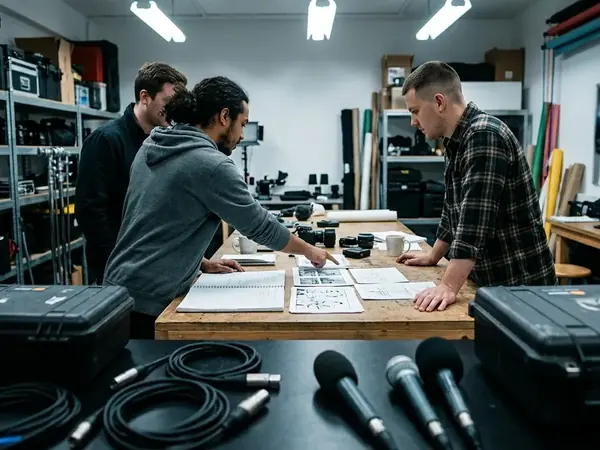
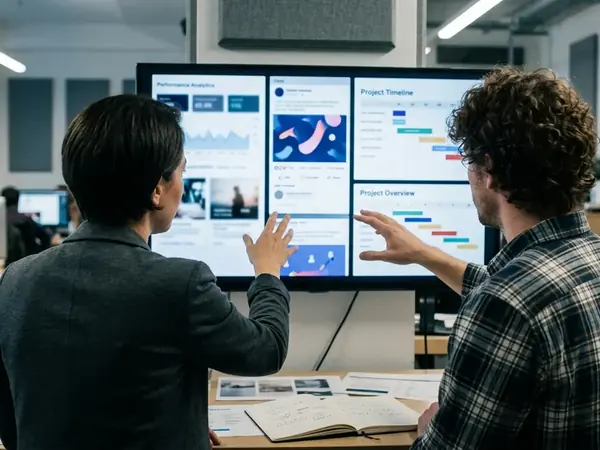
To bridge the vocabulary gap between motion designers and backend developers, studio leads instituted mandatory cross-discipline wireframing sessions. Instead of animators handing off finished video files, they co-authored the logic alongside the engineering team. This collaborative friction was particularly evident during experimental projects like the Xbox Kinect Fun Labs interfaces. The creative director acted as a translator of specialized technical jargon into unified project goals.
Pro Tip: Institute mandatory cross-discipline wireframing sessions early in the project lifecycle to align motion designers and backend developers before any high-fidelity rendering begins.
Balancing Vision with Technical Limitations
Ambitious creative concepts often required severe scope reduction to maintain performance across fragmented hardware. When ambitious 3D particle effects caused severe frame-rate drops on average consumer laptops, creative directors had to pivot. They shifted the computational load by pre-rendering the complex particles into looping video plates. Target file sizes for initial site loads were strictly capped between 1.2 MB and 2.5 MB to ensure the preloader screen wouldn't exceed a 10- to 15-second display time on standard DSL connections. We saw this exact constraint shape digital agency of record client work for brands like SunnyD.
Warning: Pre-rendering complex animations into looping background plates severely restricts dynamic lighting changes, meaning the UI overlay must rely on a fixed, high-contrast color palette to remain legible across all states.
The Enduring Legacy of Interactive Leadership
The transition from experimental web campaigns to standardized digital product ecosystems fundamentally altered creative leadership. As the industry moved away from plugin-heavy experimental sites toward standardized frameworks, creative directors adapted their workflows. They transitioned from timeline-based animation reviews to component-based design systems. Between 2015 and 2018, the migration of legacy interactive portfolios to modern responsive frameworks typically spanned a 6- to 9-month period per studio, requiring the complete rebuilding of custom easing libraries into standardized CSS transition variables.
This evolution mirrors the broader historical evolution of interactive design. Agencies like McGarrah Jessee absorbed these hybrid workflows as they acquired specialized digital shops. While these historical methodologies provide a proven foundation for interactive leadership, their application is strictly limited to bespoke, high-bandwidth marketing environments and may not scale efficiently to enterprise software development.
Key Takeaway: The degree of programmatic control handed over to developers versus timeline control retained by animators varied heavily depending on whether the project was a narrative-driven promotional site or a data-heavy product interface.