From Web Pages to Authored Experiences
The browser changed character when designers began directing time, sound, and movement inside it. A linked page could be scanned. A Flash experience asked the visitor to wait for an entrance, follow a sequence, test an object, or play through a small dramatic beat.
Agencies and studios treated that shift as an invitation. Campaign sites became stages for product stories, games, cinematic transitions, and branded entertainment. Composition extended beyond the frame: the timing of a rollover mattered, as did the silence before a sound cue and the way a loading screen prepared the next scene.
The production conditions were much less glamorous. Teams might target an initial payload roughly between 200KB and 350KB for broadband users while maintaining a secondary low-bandwidth fallback. Before a major launch, manual audio and image downsampling could occupy around 12 to 18 hours. Every polished sequence carried the pressure of uneven processors, plugin behavior, download weight, and a delivery calendar that rarely became more generous because the concept was ambitious.
The Browser as a Stage
This is where the standard history of web design becomes too flat. The interesting unit was no longer a page alone. It was an authored interval: entry, anticipation, response, transition, and return.
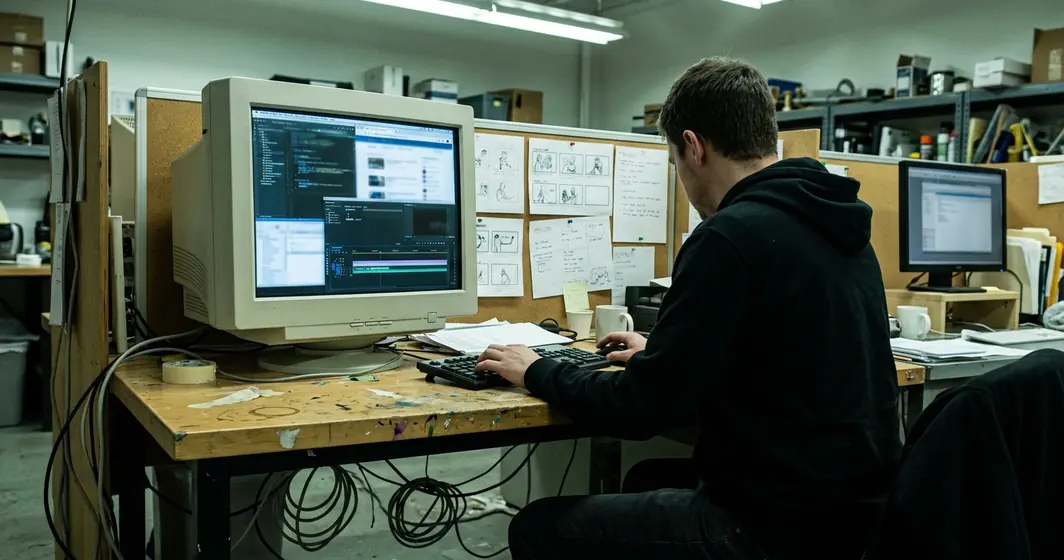
A SunnyD: digital agency of record client campaign, an entertainment release, and an experimental studio piece could use very different visual languages while sharing the same production question: how much direction could survive the trip from storyboard to an ordinary machine? The answer depended on a role that often appeared inconsistently in credits, if it appeared at all.
Follow the Constraint
When a surviving experience feels unusually deliberate, look past the surface style. Payload limits, fallback behavior, and runtime timing often reveal where the decisive creative judgment occurred.
The Role Between the Storyboard and the Runtime
Technical direction was a translation practice. The title varied by studio, and the responsibilities shifted with team size. In one production, the technical director concentrated on scripting and optimization. In another, the same function extended into client-facing technical strategy.
The work provides a more reliable definition than the job label. Technical directors interpreted storyboards, tested interaction ideas, structured assets, selected implementation methods, and protected runtime performance. They followed a composition through the full chain: source artwork, symbol organization, timeline or code architecture, input behavior, sound synchronization, and browser delivery.
Timing Across Systems
Consider a storyboard animatic built at 24 frames per second. A runtime might operate at 30 or 31 frames per second to suit common monitor behavior of the period. The conversion changed more than a number in a settings panel. Pauses tightened, motion accents shifted, and sound cues needed fresh alignment. Someone had to decide which timing expressed the idea rather than merely reproducing the animatic mechanically.
Complex physics or collision sequences could consume three to five days of pre-production before final visual assets existed. That prototype answered questions the storyboard could only suggest: Does the object feel heavy? Can the visitor interrupt the motion? What happens after an unexpected click? Where does the sequence recover?
Many technical directors handled those questions directly. They built the difficult prototype, inspected the asset structure, and solved integration problems at the point where separate contributions became one running experience. Supervisory authority might accompany the role, but the defining evidence sits in the hands-on decisions.
How Code Became a Material for Design
Typography establishes rhythm through size, spacing, and repetition. Editing shapes expectation by controlling duration and sequence. In mature Flash production, code operated in a comparable way. It could make an interface feel elastic, abrupt, hesitant, precise, or unstable.
That quality emerged through iteration. A technical director might coordinate animation states, map cursor and keyboard input, synchronize sound, arrange progressive loading, and decide which symbols should remain reusable. These choices affected the visible work. They also determined whether the experience survived sustained use.
Performance Had a Look
Garbage collection pauses could produce stutters of roughly 150ms to 300ms during heavy animation loops when assets were poorly managed. Too many transparent layers in motion placed another burden on average consumer hardware. One practical limit was three overlapping alpha-channel tweens at a time when a stable frame rate mattered.
Memory leaks presented a slower threat. Movie clips left loaded after their scenes had ended could accumulate until an extended session crashed the browser tab. The opening minute might look immaculate while the underlying structure deteriorated with every transition.
A high-fidelity automotive showroom exposed the trade-off sharply. The team first prepared pre-rendered PNG sequences for a 360-degree vehicle rotation. The approach delivered controlled imagery, yet the file size expanded beyond a workable shape. At that point, image quality, responsiveness, processor load, download weight, and production time became parts of the same design decision.
Code therefore belonged inside creative review. A motion treatment that read beautifully in a rendered preview could become sluggish under live input. A lighter solution might lose surface detail while gaining immediacy. Technical direction gave those compromises an author rather than leaving them to the final hours of implementation.
Why Technical Direction Vanished Behind the Spectacle
Successful technical work removes its own evidence. When a loading sequence holds attention, sound remains aligned, and an interaction recovers cleanly, the audience encounters a coherent experience. The engineering recedes behind the event.
Awards coverage and campaign reels reinforced that disappearance. Their narratives favored a visual concept, director, agency, or studio because those elements were easy to package. Implementation contracted into a broad development credit even when the production depended on several distinct kinds of technical judgment.
The Credit Form as a Filter
From 2004 through 2009, standard award submission forms commonly left only three to five text fields for technical roles. Studios consequently compressed specialized scripting, asset-pipeline management, and optimization under the label “Developer.” The form did not merely document the production; it edited the production history.
- A reel isolated the most spectacular sequence from its loading structure.
- A case study described the campaign idea while omitting runtime decisions.
- A short credit list merged prototype work, integration, and optimization.
- A changing title obscured continuity between similar responsibilities.
Archive labels can preserve brand and agency relationships with greater precision, including entries such as Xbox Kinect Fun Labs, McGarrah Jessee: acquiring agency, or Exopolis: digital creative agency. Technical authorship often remains harder to resolve because the surviving record uses a generic role or omits the role entirely.
That gap should prompt careful research rather than speculative credit. A polished interaction does not identify its programmer by itself. It establishes that particular production decisions occurred; attribution requires separate documentation.
Reading a Flash Experience as Production Evidence
I begin with behavior that can be seen or heard. Transitions, cursor states, loops, sound-image coordination, loading sequences, and recovery after stray input offer firmer ground than memories of how sophisticated a project once felt.
The method resembles close reading, with one important separation: observation comes first, production inference second.
A Cautious Viewing Sequence
- Record the transition. Note whether it interrupts, queues, reverses, or completes after new input.
- Watch the cursor state. Changes can indicate where the experience recognizes actionable regions or suppresses input.
- Listen for repetition. Ambient audio loops lasting four to six seconds were sometimes used to cover background asset loading.
- Compare sound and image. Consistent alignment suggests deliberate timing work, though it does not reveal the person responsible.
- Observe recovery. Repeated clicks, rapid movement, or an early exit can expose how the runtime manages unexpected behavior.
Input-to-response latency in archival video captures may appear around 33ms to 66ms, depending on the original frame rate. That measurement can support a restrained description of responsiveness. It cannot reconstruct the source architecture.
One catch matters here: a screen recording cannot reliably separate an intentional pause from hardware-induced lag introduced by the capture setup. Exact performance profiling remains unavailable without the original files. A delayed response is visible evidence; calling it a coding defect would be an unsupported conclusion.
Separate the Layers
Write “the button responds after the transition completes” before writing “the system queued input.” The first statement describes the artifact. The second proposes an implementation.
This discipline makes incomplete archives more useful. A recording can still show that the experience anticipated interruption, coordinated multiple media, or disguised loading. It simply cannot settle every question of authorship.
Put Technical Judgment Back Into the Credits
Editors, archivists, educators, and studios can improve the record with role-specific credits whenever documentation supports them. “Developer” should remain where that is the only reliable label. When production material identifies prototyping, technical direction, optimization, sound integration, or asset-pipeline work, those distinctions deserve preservation.
Ask About Decisions
Broad questions tend to produce broad recollections. “How was the project made?” often yields a campaign summary. Specific prompts return the conversation to authorship:
- Which interaction was hardest to realize?
- What changed during prototyping?
- Where did performance alter the visual design?
- Who decided how assets would load and unload?
- Who resolved timing differences between the animatic and runtime?
- Which technical option was presented to the client?
Structured interviews of roughly 45 to 90 minutes give former production staff enough room to map undocumented logic and runtime decisions. The useful material often arrives in concrete fragments: a discarded sequence, a loading workaround, a late sound revision, or the name of the person who stabilized a difficult scene.
Portfolio and archive entries should place those accounts beside the public-facing imagery. Preserve the role label as it appeared, explain implementation constraints, identify available process material, and mark uncertainty where credits conflict. This produces a richer record without assigning authorship on aesthetic intuition alone.
Surviving decompilations can also be cross-referenced with studio pitch decks when both exist. One exposes traces of implementation; the other records intended behavior before production compromises altered it. Together they can test whether a runtime choice followed the original design or emerged during development.
The recovery window is already historically narrow: the most relevant surviving pitch decks and technical artifacts in this record come from 2001 to 2008.