The Debrief Is the Studio Record That Keeps Thinking Alive
A candid production debrief may be the most valuable record a creative studio keeps. Finished files preserve an outcome. The conversation around those files preserves the reasoning that made the outcome possible: decisions taken under pressure, disagreements resolved late, constraints absorbed into the design, and possibilities left outside the final build.
I have opened too many inherited project folders that contain everything except an explanation. The assets are present, the application runs, and the naming conventions are mostly legible. Yet the central questions remain unanswered. Why did the navigation become linear? Why does the sound drop out at a particular transition? Which visual behavior was intentional, and which was accepted because the delivery window had closed?
Record the Reasoning Layer
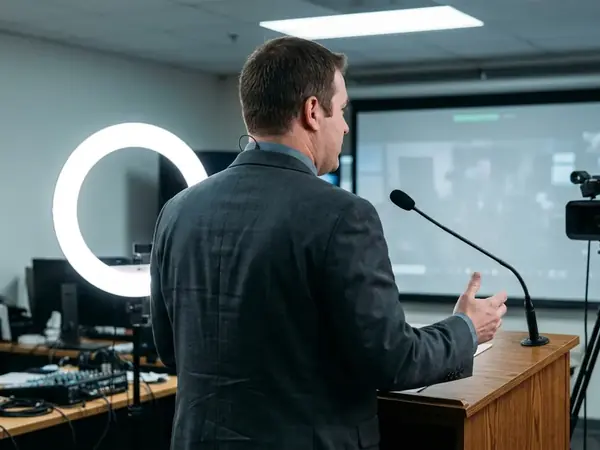
A focused audio session of roughly 45 to 60 minutes can reconnect those fragments. It gives designers, animators, developers, producers, and creative leads enough room to describe the route through the work without turning the meeting into a retrospective performance.
For an archive concerned with Exopolis and its production history, the raw conversation belongs beside the production objects. Retaining the original .wav recording with the final .swf and source .fla assets creates an interpretive layer around the build. A future reader can inspect both what shipped and how the studio understood it at the time.
What Finished Interactive Work Erases
Twenty or thirty incremental saves can accumulate during a two-week sprint. That sequence appears richly documented until someone tries to reconstruct the decisions between versions.
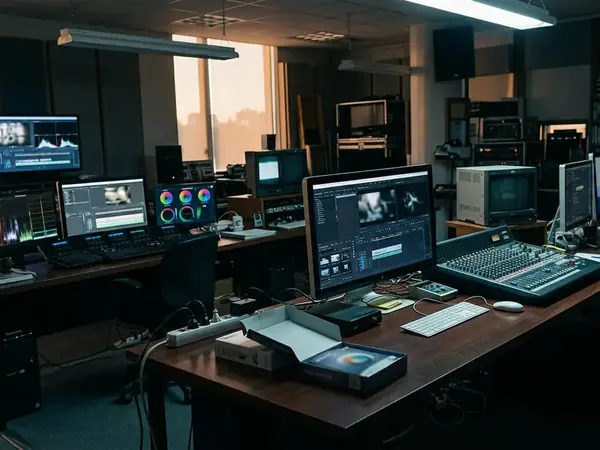
A project folder might show a button moving across three compositions, a motion sequence becoming shorter, or an interface state disappearing. ActionScript class files can document state changes with considerable precision. They rarely explain whether the change followed usability feedback, a performance problem, a client request, or a creative disagreement.
Versions Preserve States, Not Motives
Launched websites, motion pieces, and digital campaigns usually present a coherent surface. Case studies tighten that coherence further. Reels select the strongest passages, approved deliverables suppress unfinished branches, and portfolio captions convert a turbulent production path into a clean statement of intent.

The erased material matters because interactive work develops through partial tests. A disputed transition may reveal how the team understood pacing. An incomplete prototype may show that the original interaction model depended on a browser capability the audience could not reliably use. Even a poorly labeled export can identify the moment when motion and development stopped working from the same assumptions.
Folder archaeology can establish chronology. A debrief supplies causality. Used together, they prevent the latest modification date from becoming the studio’s accidental account of authorship.
Abandoned Routes Reveal How Collaboration Actually Worked
Discarded concepts define the edge of a project’s ambition. They show which parts of the brief invited exploration, where creative preference met production necessity, and how much of the final form emerged through negotiation among disciplines.
A Composite Production Sequence
Consider this clearly identified composite, assembled from a common interactive production pattern rather than presented as a specific historical project. A team sketches a fully 3D-rendered navigation carousel and translates the drawing into a motion test. Development then attempts to reproduce the behavior with a third-party rendering library.
After three days of interaction testing, CPU usage spikes on standard dual-core machines. The technical finding changes the collaborative problem. Motion can no longer hand development a continuous 3D behavior and expect a direct implementation. Development needs a lighter execution model; design wants to retain the sense of dimensional movement.
The surviving approach uses pre-rendered motion sequences playing at 24 frames per second, triggered by the user’s mouse-x coordinate. Motion now prepares controlled image sequences. Development maps horizontal input to those frames. Design adjusts the carousel so the illusion remains readable within the reduced range of movement.
The final interaction may look inevitable when viewed alone. The debrief reveals its mixed authorship. It can identify who introduced the carousel, who diagnosed the processing load, where the handoff changed, and which feedback preserved the idea in altered form. That account gives proper weight to the people who transformed a concept rather than merely originating or approving it.
Technical Compromises Belong in the Creative History
Implementation constraints leave visible marks on composition, pacing, sound, typography, and navigation. Treating them as incidental production trivia removes part of the design history.
Recover the Operating Conditions
A useful debrief asks concrete questions. Which browsers and plugin versions defined the support floor? How long could the opening load hold attention? Did video decode smoothly while animation and sound were active? What display dimensions framed the primary canvas? Which assets consumed the weight budget, and which deadline prevented another rendering pass?
Period thresholds make these questions legible. Compressing an FLV video asset below roughly 2.5 megabytes for an audience using broadband around 1.5 Mbps could shorten a shot, soften an image, or encourage segmented playback. Targeting a baseline display resolution near 1024 by 768 pixels could limit type size, constrain persistent navigation, and reduce the usable area once browser chrome was considered.
These decisions operate in chains. More aggressive video compression may preserve loading behavior while degrading gradients and fine motion. A smaller canvas may keep controls visible while reducing the scale of an image-led sequence. Pre-rendering can stabilize playback, yet it also fixes timing that a real-time system might have allowed the user to interrupt.
The debrief should capture the chain, not merely the threshold. Record which constraint appeared, who evaluated it, what alternatives remained viable, and which expressive quality changed in the delivered build. Hardware and network conditions can only be reconstructed approximately; the participants’ explanation shows how those conditions entered the creative judgment.
Candor Becomes Evidence Only When the Studio Protects It
Listen closely to an unedited debrief and the studio’s working culture emerges in small signals. A pause before naming an approval problem can carry more meaning than a formal status report. Humor may indicate shared frustration. Overlapping recollections can expose a handoff that different disciplines understood in incompatible ways.
Credit also travels through tone. One participant may consistently describe decisions as collective, while another remembers the person who solved a specific rendering or compression problem. Preserving both accounts offers a richer record than smoothing them into a single institutional voice.
Set Access Before Recording
Candor requires known boundaries. Before the session begins, participants should understand whether audio is being recorded, who can access it, and how quotations may later be used. The archive also needs a defined route for restricting client, budget, and personnel material.
One workable model holds unedited transcripts under limited access for about a year to eighteen months after launch. Highly sensitive client budget discussions still require manual redaction before the audio enters a general studio archive. The restriction should travel with the file rather than survive as an informal promise remembered by one producer.
Hierarchy shapes the session as strongly as the questions do. Junior participants may defer to a creative lead’s account, and a producer’s chronology may overshadow the designer or developer who experienced the turning point directly. Facilitators can counter this by asking each discipline to describe the same decision before opening the floor for synthesis.
A debrief remains a situated record. It reflects the people present, the access rules in force, and the moment at which they spoke. Preserve those conditions alongside the transcript so later readers can interpret its silences as carefully as its claims.
File the Next Debrief Beside the Finished Work
The procedure can stay compact. Schedule the conversation within two or three days of final asset delivery, while build decisions remain specific and before participants disperse to other assignments.
Ask Five Production Questions
- What changed? Identify the largest difference between the initial direction and the delivered work.
- What was abandoned, and why? Name concepts, prototypes, transitions, or behaviors that disappeared.
- Which constraint altered the outcome? Connect browser support, asset weight, rendering, schedule, or delivery conditions to a visible design decision.
- Where did collaboration shift the work? Locate the handoff, critique, or technical intervention that redirected the project.
- What would a future team otherwise misunderstand? Surface the decision that files and approved documentation cannot explain alone.
Retain the original recording or contemporaneous notes. Add a searchable transcript when resources allow; otherwise, prepare a concise summary with time references to the significant passages. The summary should guide access to the source rather than replace it.
Attach the Archive Context
Tag the record with five standardized metadata fields: Project Title, Debrief Date, Participant Roles, Build ID or Relevant Deliverable, and Access Level. Keep the identifiers consistent with the corresponding build, source files, and final export. This small discipline prevents a valuable conversation from becoming an isolated audio file with no reliable project relationship.
Open the production calendar now, book a 45-minute debrief within three days of the next delivery, and place those five prompts in the invitation.