A Timecode Between the Story and the Tape
A timecode anchored every 30 to 90 seconds lets a researcher jump from a written citation to the stretch of audio where a designer describes a launch-night code patch. That link is the record. A polished paragraph with no time reference cannot be checked against the voice that produced it.
Interactive builds from 2006 to 2012 frequently survive only as screen-captured video or a broken directory tree. Zero documentation remains on why a specific easing curve or navigation state changed hours before deployment. Critique rituals, production handoffs, technical compromises, and informal troubleshooting never entered the case study.
The shipped file shows a result.
The reusable kit is a set of linked pieces: interview prompts, a permissions sequence, recording instructions, transcription conventions, and an archive-entry template. Drawing on that modular file set, an interviewer can revise transcription rules without invalidating signed permission forms or existing metadata templates. A single handbook would force the opposite. Touch one chapter and every related form goes stale.
The same thin trail runs through branded digital culture of that period. Xbox Kinect Fun Labs and a consumer microsite both collapse to a video file once the directory breaks. SunnyD, as a digital agency of record client, marks the volume problem: weekly critiques outrun any reel. McGarrah Jessee, the acquiring agency, sits upstream of the floor where those timelines were actually made. A digital creative agency such as Exopolis lives on that floor. The kit is for the people who touched the files.
Bound the Session to One Job and One Role
Early documentation often tried to cover a participant's entire multi-year tenure in one sitting. The pages filled with generalizations. The workable session is narrower: one interactive campaign launch, one motion-design handoff, or one recurring critique.
I assemble a one-page project card 3 to 5 days before the session. It records the approximate period, the interviewee's role at that time, project responsibilities, the exact credit or working role, and 2 to 4 cleared visual prompts. Reference materials land on the card only when they can be placed on the table.
Creative leadership can narrate the approved frame. Pair a motion designer with the front-end developer who received the timeline exports and a different account appears: handoff friction directors rarely witnessed. Interview at least two disciplines. Select for relationship to the work. A junior present at every critique on that campaign can reconstruct sequence more reliably than a principal who approved the last frame and left.
What the Card Must Hold
- Build window for a single deliverable
- Role and credit as they stood then
- Responsibilities the speaker carried
- Two to four cleared visual prompts
Prompts That Walk a Decision Backward
Speakers default to portfolio narrative once the recorder is on. Agency pitch rhetoric is faster than a failed prototype. Question order has to reach the artifact before that version locks in.
Move from physical artifacts toward technical constraints, and leave retrospective opinion until both are named. A 45-to-60-minute session typically covers five core questions and holds 10 to 15 minutes per artifact. Use that span to trace who attended the review, which alternative interactions were discarded, and how the runtime build diverged from the motion study.
The sequence runs from role and project context to a specific decision, its constraints, the handoff, and interpretation.
- Walk me through a typical critique on this project.
- Which interaction changed after the first prototype, and why?
- How did the motion work reach the implementation team?
- What happened when a build behaved differently from the storyboard?
- What did a new starter have to learn by watching someone else?
Follow-ups recover sequence and evidence. Who was present. What alternatives were discussed. What artifact survives. What the interviewee personally observed, separate from lore heard later. Intended frame rates and bezier timing in the animation software stay in one set of answers. Rendering behavior in period web browsers stays in another. Those two clocks rarely matched, and a merged reply hides the mismatch.
Artifact Before OpinionOpen on the storyboard, the export, or the broken build. Judgment waits until the speaker has named the room and the options thrown out.
A Recording Yes and a Later Publication Clearance
Veterans speak more candidly when a sensitive line about a client or a colleague can come out after they hear themselves. Recording consent is granted in the room. Publication clearance waits for the transcript.
Keep the checklist compact: recording, transcription, quotation, naming, online publication, and access to the complete interview. Record the agreed review process, the correction procedure, access restrictions, and any deadline or practical limit on withdrawal before publication. A date with no procedure becomes an argument on index day.
Participants receive a 14-to-21-day transcript review window to request line-level redactions, specify naming preferences, or restrict segments to internal archive access. No entry is indexed before that window closes.
Permission to record a conversation does not automatically authorize public release of its audio, transcript, client materials, or third-party contributions.
Standard oral-history release forms cannot override surviving non-disclosure agreements or third-party intellectual property claims on unlaunched client prototypes. If the prototype never shipped, those claims still govern what can be quoted.
Small-Cohort NamingRedacting a speaker's name rarely guarantees anonymity in a studio cohort of 8 to 15 people when the transcript still names a campaign module or a proprietary animation tool. Internal access is the honest option when anonymity is the request.
An Untouched Master Beside the Reading Copy
Quiet room. Short playback check. A cardioid microphone sits 15 to 20 centimeters off-axis from the speaker. Capture uncompressed WAV at 48 kHz / 24-bit, and open with 20 seconds of room tone. Log the interview date, participant names or approved identifiers, and the interviewer's identity before the first project question.
The original recording stays unchanged. Working copies carry access controls. A backup sits in a separate store. Archivists keep that preservation master beside the edited reading transcript so a later researcher can test vocal inflection, hesitation, and contested terminology against the raw audio. A smoothed paragraph cannot hold a swallowed filename or two voices crossing.
Automated transcription needs listening-based correction, particularly for studio names, software terminology, overlapping speech, and project titles. Human review runs 3 to 4 hours per recorded hour, most of it spent on garbled file formats, custom script names, action-scripting terms, and overlapping studio slang. Speech-to-text engines phoneticize period jargon and obsolete file extensions into ordinary English that means nothing. Motion-handoff interviews show the damage first. The vocabulary is local. The extensions are gone.
Terms the Machine Will Mangle
- Custom script names and action-scripting vocabulary
- Obsolete file extensions spoken as if still current
- Overlapping speech during a build argument
- Project titles that share words with later jobs
Two Dates So a Query Stays Honest
A complete catalog record holds 13 standardized fields, pairing a 120-to-180-word factual abstract and 4 to 8 controlled vocabulary tags with stable file paths to the master audio and the cleared transcript version. Cross-link conflicting memories of the same build week through a shared project identifier, and leave each account intact.
Fields on the Entry
- Interview identifier
- Approved display name
- Role during the project
- Project title
- Interview date
- Period discussed
- Interviewer
- Short abstract
- Topic tags
- Permissions status
- Access level
- Related artifact references
- Transcript version
- Recording location
Interview date and period discussed never share a column. The four-digit project era is the time being remembered. The capture date is when the person spoke. A query for 2008 interactive work will otherwise mix contemporary build logs with retrospective interviews recorded fifteen years later. Testimony and production files answer different questions.
Use consistent terms for interaction design, motion design, development, production, critique, and client feedback. Where an alternate project name is verified, record it beside the primary title. Unverified nicknames from a reel stay off the entry.
Era Versus CaptureKeep the project era out of the interview-date field. Otherwise a search for period work treats later testimony as a build log from the same week.
A Hypothetical Desk and a Twelve-Panel Board
Test the kit on one bounded handoff before anyone schedules a multi-person cohort. Folder names, timecode brackets, and uncertainty flags either survive a real catalog entry or they fail in private, where the damage is cheap.
The scene that follows is hypothetical. It does not describe an actual Exopolis project or employee.
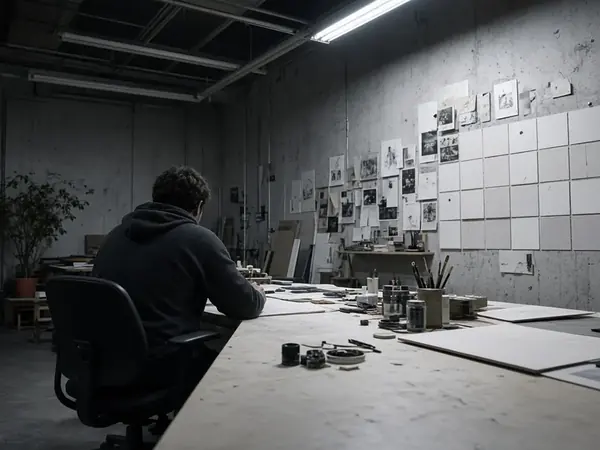
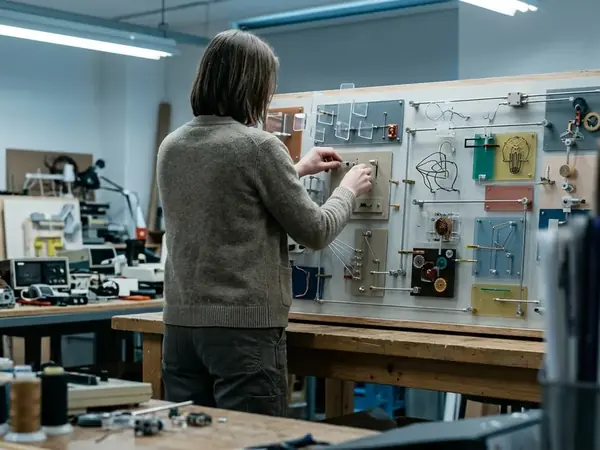
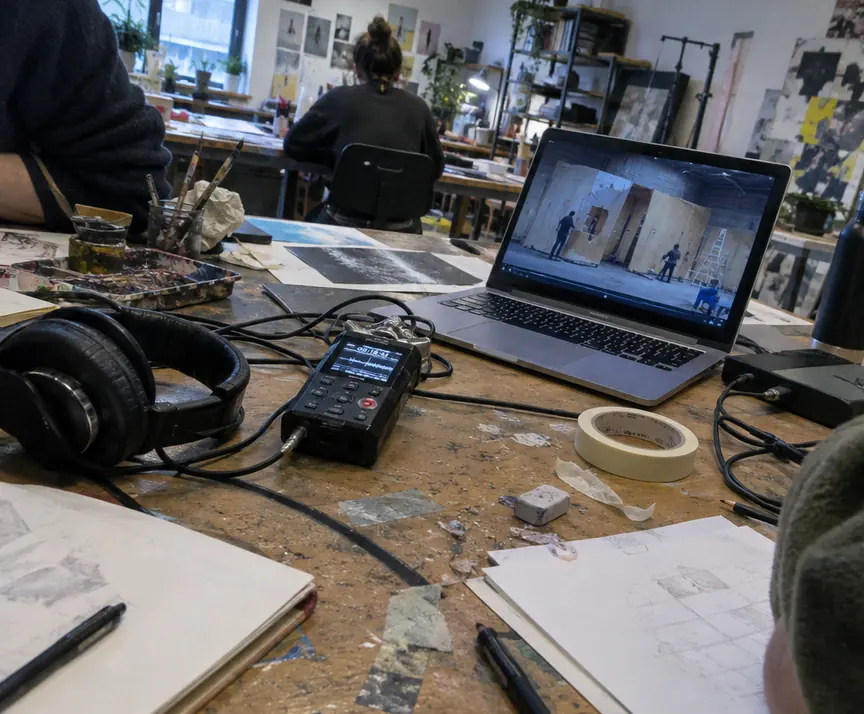
A motion designer sits at a quiet studio desk with a 12-panel storyboard from a 2009 interactive campaign. The session runs shy of 35 minutes. She walks the panels in order and stops where a complex particle transition became a 4-frame sprite sequence during final integration. She ties the change to the runtime: the build could not carry the particle system the motion study had assumed. She names the export she handed over and the moment the storyboard and the browser parted company.
The archive entry links a 2-minute cleared excerpt, timecoded 00:14:10 to 00:16:05, to the storyboard scan. An unverified build date is flagged for follow-up with the project's lead developer. The master audio stays untouched. The project era, 2009, sits in a different field from the date of this interview.
She slides the twelfth panel aside. The room tone from the opening twenty seconds is still sitting at the head of the file.